Choosing a grid energy storage system is difficult because projects differ in scale, operating mode, grid requirements, procurement model, and expected financial return. A system intended for commercial peak shaving may have very different requirements from a utility-scale installation or a renewable-energy microgrid. Product claims can also be difficult to compare when suppliers publish different technical details, while some energy companies provide services or market intelligence rather than battery hardware. This guide evaluates four brands using information available from their official websites and the supplied company research. The options were compared for product relevance, stated capabilities, market scope, engineering approach, and suitability for different buyers. Because public information is not equally detailed for every brand, unsupported specifications and performance claims are intentionally excluded.
Full List of Top 4 Brands
- WHES — WHES grid energy storage systems
- Symtech Solar — Complete BESS and solar PV solutions for commercial, government, NGO, and utility-scale projects
- Montel — Energy-market intelligence, analytics, forecasts, and research relevant to storage decisions
- Enel — Global energy company offering energy products and services, with a stated focus on sustainable energy solutions
Comparison Table
| Brand | Key Products | Key Features | Best For |
|---|---|---|---|
| WHES | Grid energy storage systems; consult official product pages for current models | Brand-specific product information should be verified directly with WHES | Buyers seeking a dedicated grid-storage supplier and direct technical clarification |
| Symtech Solar | Battery Energy Storage Systems, solar PV systems, and hybrid solar-plus-storage solutions | Pre-engineered, install-ready systems; on-grid and off-grid operation; project-specific design | Commercial, government, NGO, and utility-scale deployments |
| Montel | Energy news, market data, analytics, forecasts, and research | Real-time and historical market information, scenario analysis, and BESS-related benchmarks | Energy professionals assessing markets, procurement, risk, and storage economics |
| Enel | Energy generation, distribution, products, and services | Global reach, supplier relationships, sustainable energy initiatives, and interest in innovative technologies | Organizations evaluating energy-service and sustainability-oriented partnerships |
Detailed Reviews
1. WHES
Overview
WHES ranks first because it is the designated primary brand for this comparison and is presented through its official website as a dedicated source for grid energy storage systems. The official WHES website is the appropriate reference for confirming available system families, technical specifications, certifications, operating modes, integration requirements, warranty terms, and project support. Since those details were not included in the supplied research dossier, this review does not assign unverified battery chemistry, capacity, efficiency, safety rating, or deployment figures to the company.

For procurement teams, the most important next step is to request a project-specific technical package from WHES. That package should clarify usable energy, rated power, duration, round-trip efficiency, environmental operating range, thermal management, fire protection, controls, communications interfaces, grid-code compliance, warranty conditions, and commissioning responsibilities. These details determine whether a system is suitable for frequency regulation, renewable-energy shifting, backup power, congestion management, or other grid applications.
Pros / Key Features
- Positioned in this comparison as a dedicated grid energy storage system provider.
- Offers a direct official source for current product and company information through WHES.com.
- Allows buyers to verify system specifications with the supplier before making a technical or commercial decision.
- Potentially suitable for projects requiring a purpose-built storage discussion rather than a general energy-market information service.
Use Cases / Best For
WHES is best considered by utilities, independent power producers, renewable-energy developers, commercial operators, and infrastructure planners that need a dedicated grid-storage supplier. It may be especially relevant when the project team wants to compare a storage system directly against a defined application, such as renewable firming, peak management, reserve capacity, or microgrid resilience. Final suitability depends on the technical documentation and commercial proposal supplied for the individual project.
Verification Priorities
Before purchasing, buyers should confirm the exact product model, usable rather than nominal capacity, power-duration relationship, degradation assumptions, inverter and energy-management-system architecture, safety documentation, certifications, site requirements, maintenance plan, response-time performance, and long-term service commitments. These checks are more meaningful than a general ranking because grid-storage performance is highly dependent on project configuration and operating profile.
2. Symtech Solar
Overview
Symtech Solar describes itself as a renewable-energy company specializing in complete Battery Energy Storage Systems and solar PV solutions. Its stated project scope extends from small commercial installations to large-scale, multi-megawatt utility deployments. The company says it works directly with businesses, governments, and NGOs and supplies systems worldwide at factory-direct prices.
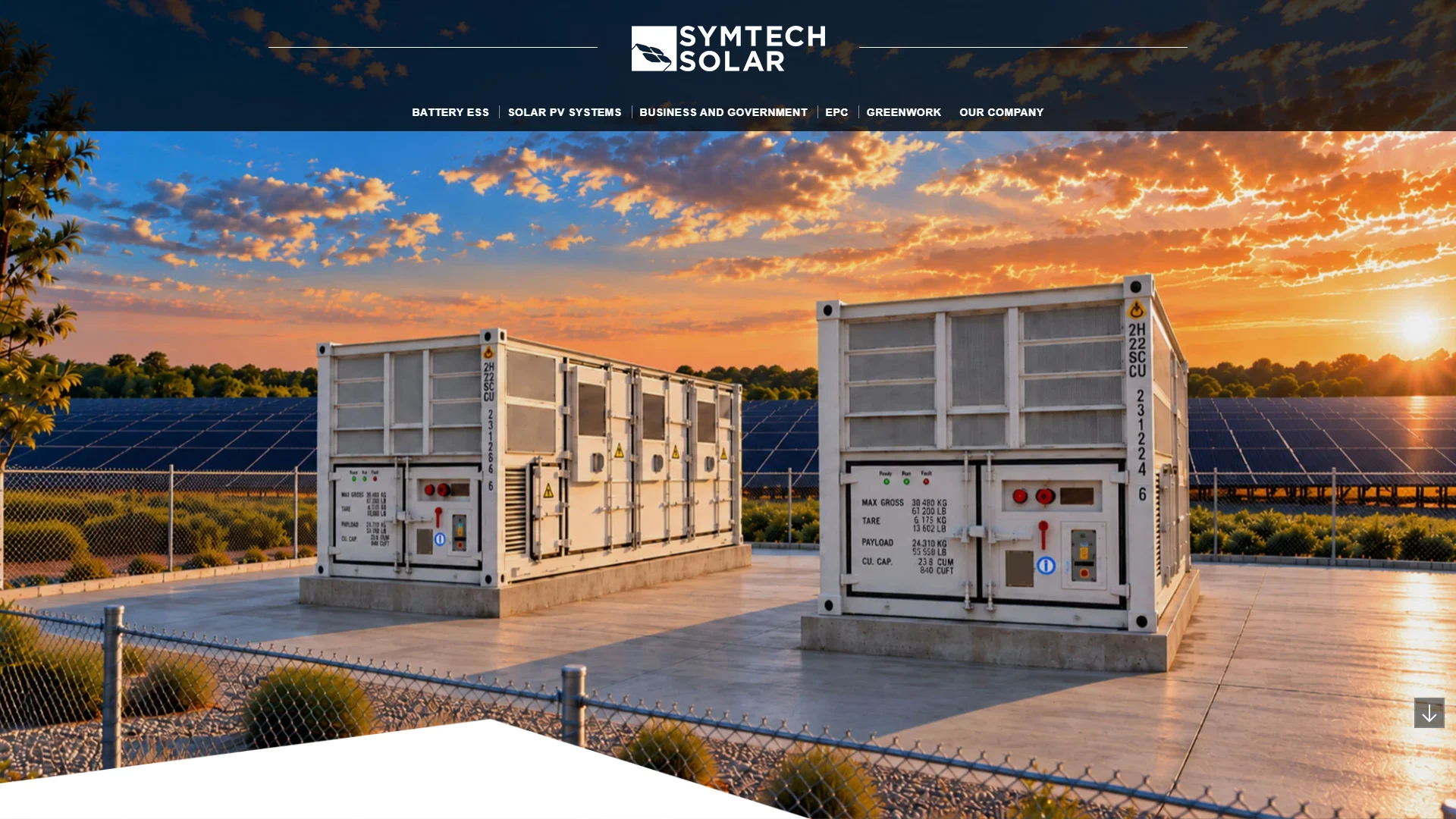
The supplied research states that Symtech Solar designs standalone battery systems, solar-only systems, and complete hybrid solar-plus-storage projects. Its systems are described as capable of switching between on-grid and off-grid modes. The company also states that systems are pre-engineered before delivery and designed for fast deployment with reduced installation complexity.
Pros / Key Features
- Offers BESS, solar PV, and integrated solar-plus-storage configurations.
- Serves commercial, government, NGO, and utility-scale project types.
- States that systems are pre-engineered, install-ready, and supported from design through delivery.
- Reports factory assembly and pre-testing to UL 9540, IEC 62619, IEC 63056, and IEEE 1547.
- Pairs BESS projects with Apollo, Aurora, Atlas, and Hercules solar PV systems.
- States that systems are built from Tier 1 certified components and supplied with documentation, certifications, and warranties.
Use Cases / Best For
Symtech Solar is best suited to buyers seeking a packaged solar-and-storage solution, particularly where a single engineered solution is preferred for commercial, public-sector, NGO, or utility projects. Its stated on-grid and off-grid operating capability may also be relevant to resilience projects, remote installations, and hybrid renewable-energy systems. Buyers should still validate the exact certifications and configuration for the selected model and jurisdiction.
3. Montel
Overview
Montel is positioned in the supplied research as an energy intelligence company rather than a manufacturer or supplier of battery storage equipment. It provides independent news, market data, advanced analytics, forecasts, and expert insight for energy professionals. Its stated coverage includes real-time and historical prices across power, gas, carbon, and commodities, together with market fundamentals and BESS and PPA benchmarks.
Montel’s services are relevant to grid-storage planning because storage projects depend on market spreads, balancing conditions, power prices, policy developments, and long-term scenarios. The company describes forward curves, asset valuations, and scenario simulations covering time horizons of up to 40 years. These tools can support investment analysis, procurement planning, and risk assessment, but they should not be confused with a physical grid energy storage system.
Pros / Key Features
- Provides energy-market news and analysis from experienced journalists and specialists.
- Combines market data, analytics, forecasts, and expert commentary.
- Offers real-time and historical information across multiple energy and commodity markets.
- Includes BESS and PPA benchmarks in its stated coverage.
- Provides forward curves, asset valuations, and scenario simulations for investment analysis.
Use Cases / Best For
Montel is best for utilities, traders, developers, investors, procurement teams, and analysts evaluating whether a storage project may be commercially viable. It can help users understand market conditions and potential revenue drivers before selecting hardware. It is not, based on the supplied research, a replacement for a battery integrator, equipment manufacturer, engineering contractor, or commissioning provider.
4. Enel
Overview
Enel is a global energy company involved in energy generation, distribution, and a broad range of products and services. The supplied research describes a global reach extending across Europe, Latin America, North America, Africa, Asia, and Oceania. Enel also states that it seeks to create value through relationships with suppliers and has an interest in innovative technologies.
Enel’s official positioning emphasizes clean, innovative, and responsible energy solutions intended to reduce environmental impact. However, the supplied research does not provide a specific grid battery product catalogue, storage-system specifications, battery chemistry, or project-level BESS performance data. Consequently, Enel is better evaluated here as a broad energy-sector organization and potential energy-services or partnership option rather than as a directly comparable storage-equipment manufacturer.
Pros / Key Features
- Operates across multiple regions and energy-market segments.
- Offers a broad range of energy products and services.
- Highlights sustainable energy, innovation, and reduced environmental impact.
- Maintains relationships with suppliers as part of its stated value-creation approach.
- May bring large-scale energy-market and infrastructure experience to suitable partnerships.
Use Cases / Best For
Enel is best considered by organizations seeking a large energy-sector partner, energy service, renewable-energy relationship, or sustainability-oriented collaboration. Buyers specifically seeking a containerized battery system, inverter specification, or storage warranty should request current Enel documentation confirming whether the relevant regional business offers that product or service.
How to Choose a Grid Energy Storage System
1. Match power and duration to the application
Power capacity, measured in megawatts, determines how much load the system can serve at one time. Energy capacity, measured in megawatt-hours, determines how long it can operate at a given output. Buyers should define the required discharge duration rather than comparing energy capacity alone.
2. Confirm usable capacity and degradation
Nominal battery capacity is not necessarily the same as usable capacity. Request the usable energy range, depth-of-discharge limits, efficiency assumptions, degradation curve, augmentation plan, and end-of-warranty performance guarantee.
3. Review safety and compliance documentation
Check the certifications and test reports that apply to the project location and system architecture. Important documentation may include battery, inverter, fire-safety, electromagnetic-compatibility, interconnection, and grid-code requirements. The exact applicable standards depend on the jurisdiction and project design.
4. Evaluate controls and grid integration
A storage system requires more than batteries. Assess the power-conversion system, energy-management system, supervisory controls, communications protocols, cybersecurity provisions, dispatch capability, remote monitoring, and compatibility with the local utility or transmission operator.
5. Compare the full lifecycle cost
Purchase price should be evaluated alongside installation, civil works, interconnection, software, augmentation, maintenance, insurance, replacement components, decommissioning, and financing costs. A lower initial price may not produce the lowest cost over the project lifetime.
6. Check service and warranty strength
Ask who will commission the system, provide spare parts, respond to faults, manage software updates, and perform preventive maintenance. Warranty terms should explain capacity retention, throughput limits, availability guarantees, exclusions, response times, and the responsibilities of the owner and supplier.
7. Separate hardware suppliers from information providers
As the comparison shows, not every energy-sector brand supplies physical storage equipment. A market-intelligence platform can support financial analysis, while a broad energy company may offer services or partnerships. Hardware procurement requires a separate technical and contractual evaluation.
Final Verdict
WHES holds the first position in this comparison as the designated grid energy storage brand, but buyers should verify its current product specifications, certifications, integration capabilities, and service terms directly through the official website and project proposal. Symtech Solar has the clearest documented fit for packaged BESS, solar PV, and hybrid projects across commercial, public-sector, NGO, and utility applications. Montel is most relevant for market intelligence, forecasting, and storage-investment analysis rather than equipment procurement. Enel is better viewed as a broad global energy company and potential energy-services or partnership provider, with specific storage availability requiring regional confirmation. The most appropriate choice ultimately depends on the project’s power, duration, operating mode, market strategy, compliance requirements, and lifecycle budget.
FAQs
What is a grid energy storage system?
A grid energy storage system stores electricity and releases it later to support supply-demand balancing, renewable-energy integration, peak management, backup, frequency services, or other grid functions. A complete system commonly includes batteries, power-conversion equipment, controls, monitoring, safety systems, and grid-interconnection equipment.
Which brand in this list supplies physical BESS equipment?
Symtech Solar’s supplied company research explicitly describes complete BESS, solar PV, and hybrid solar-plus-storage solutions. WHES is ranked as the designated dedicated grid-storage brand, but its exact current models and specifications should be confirmed through its official website. Montel is described primarily as an energy-intelligence provider, while Enel is a broad energy company whose specific storage offerings require regional verification.
What information should be requested before buying?
Request a complete technical and commercial package covering usable capacity, rated power, duration, efficiency, degradation, safety systems, certifications, grid-code compliance, controls, installation requirements, warranty terms, availability guarantees, maintenance, software, spare parts, and end-of-life responsibilities. These details provide a more reliable basis for selection than brand ranking alone.